

ChainBreaker Agent: AI-Powered Supply Chain Defense
Understand how ChainBreaker protects your supply chain from vulnerabilities using AI. Learn its function and how you can access it.
Fusion Cyber's product writing team delivers insights on cutting-edge cybersecurity solutions. Learn more at fusioncyber.co.
Overview
ChainBreaker Agent is an AI-powered tool designed to safeguard enterprise supply chains by detecting malicious packages, known CVEs, lock file tampering, and typo squatting in pull requests (PRs) and direct commits. It prevents vulnerable code from reaching production, ensuring robust supply chain security. This post explores ChainBreaker's functionality, its integration into workflows, and how it benefits enterprises.
What is ChainBreaker Agent and how does it help?
ChainBreaker Agent is a proactive cybersecurity solution designed to fortify your supply chain against emerging threats. As an AI-driven tool, it effectively identifies and mitigates risks associated with malicious packages, known CVEs (Common Vulnerabilities and Exposures), lock file tampering, and typo squatting in pull requests and direct commits. This ensures that potential threats are neutralized before they can infiltrate production environments. ChainBreaker functions as a standalone service, seamlessly receiving GitHub webhooks to analyze dependency changes in a controlled sandbox environment. By providing a comprehensive risk score and detailed analysis for each pull request, ChainBreaker allows developers and security teams to assess and respond to potential vulnerabilities efficiently. The demo indicates that ChainBreaker posts comments on PRs with a risk score, and if the score exceeds a certain threshold, it alerts developers via Slack, thereby integrating seamlessly into existing communication channels.
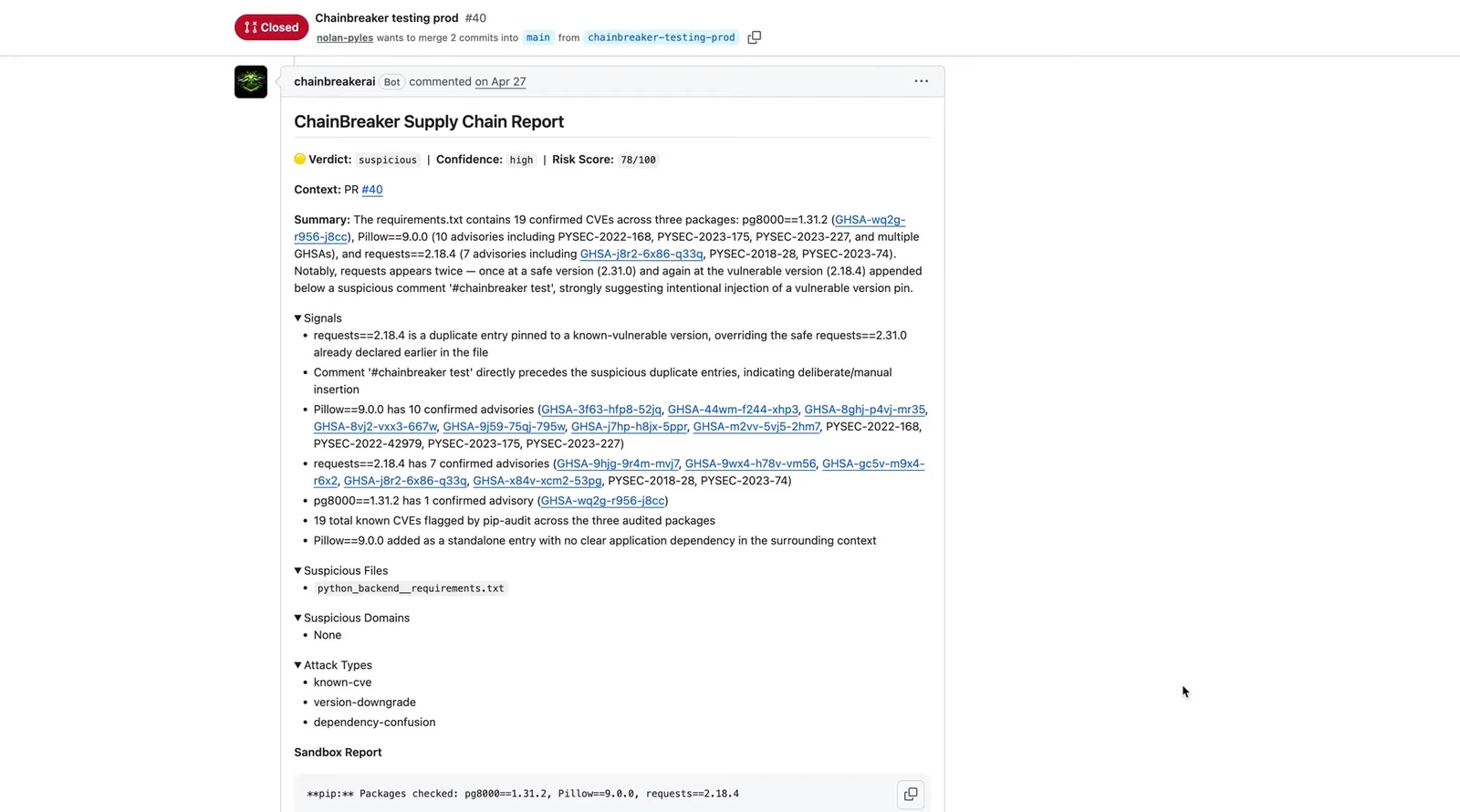
The ChainBreaker Agent generates a detailed supply chain report highlighting vulnerabilities.
How does Chainbreaker integrate into your workflow?
Integrating ChainBreaker into your workflow is straightforward and enhances your existing CI/CD pipeline. The demo shows that ChainBreaker operates by receiving GitHub webhooks to monitor dependency changes. Once a PR or commit is made, ChainBreaker evaluates the changes in a sandbox environment and generates a risk score. This score reflects the potential threat level, with detailed findings provided to the developers. If the risk score surpasses a pre-defined threshold, ChainBreaker sends an alert via Slack to the developer responsible for the PR. This real-time notification system ensures that developers are immediately aware of any potential issues, allowing them to take corrective action promptly. This integration not only enhances security but also streamlines the development process by embedding security checks directly into the workflow.
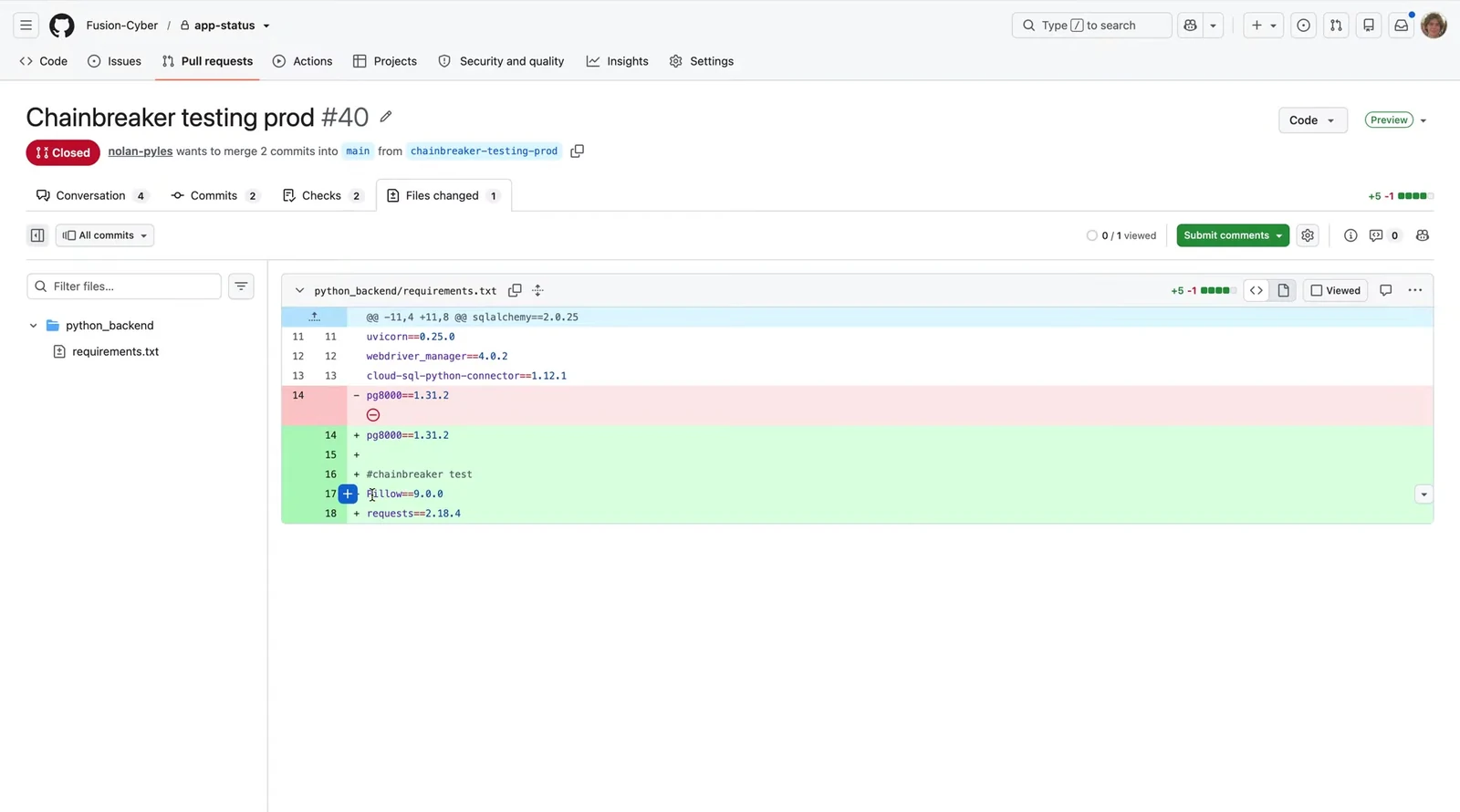
The product displays a code view with highlighted changes in the requirements file.
What tasks does ChainBreaker handle?
ChainBreaker is adept at handling several critical tasks that are essential for maintaining supply chain security. According to the demo, it performs the following functions:
- Detects and alerts on malicious packages to prevent their inclusion in production code.
- Identifies known CVEs within added dependencies, providing a risk score and detailed findings.
- Monitors for lock file tampering, ensuring that dependency integrity is maintained.
- Recognizes typo squatting attempts in PRs and commits, which are common tactics used by attackers to introduce malicious code.
- Maintains an SBOM (Software Bill of Materials) database, allowing for the tracking and auditing of dependencies.
By automating these tasks, ChainBreaker significantly reduces the manual effort required for vulnerability management, enabling security teams to focus on more strategic initiatives.
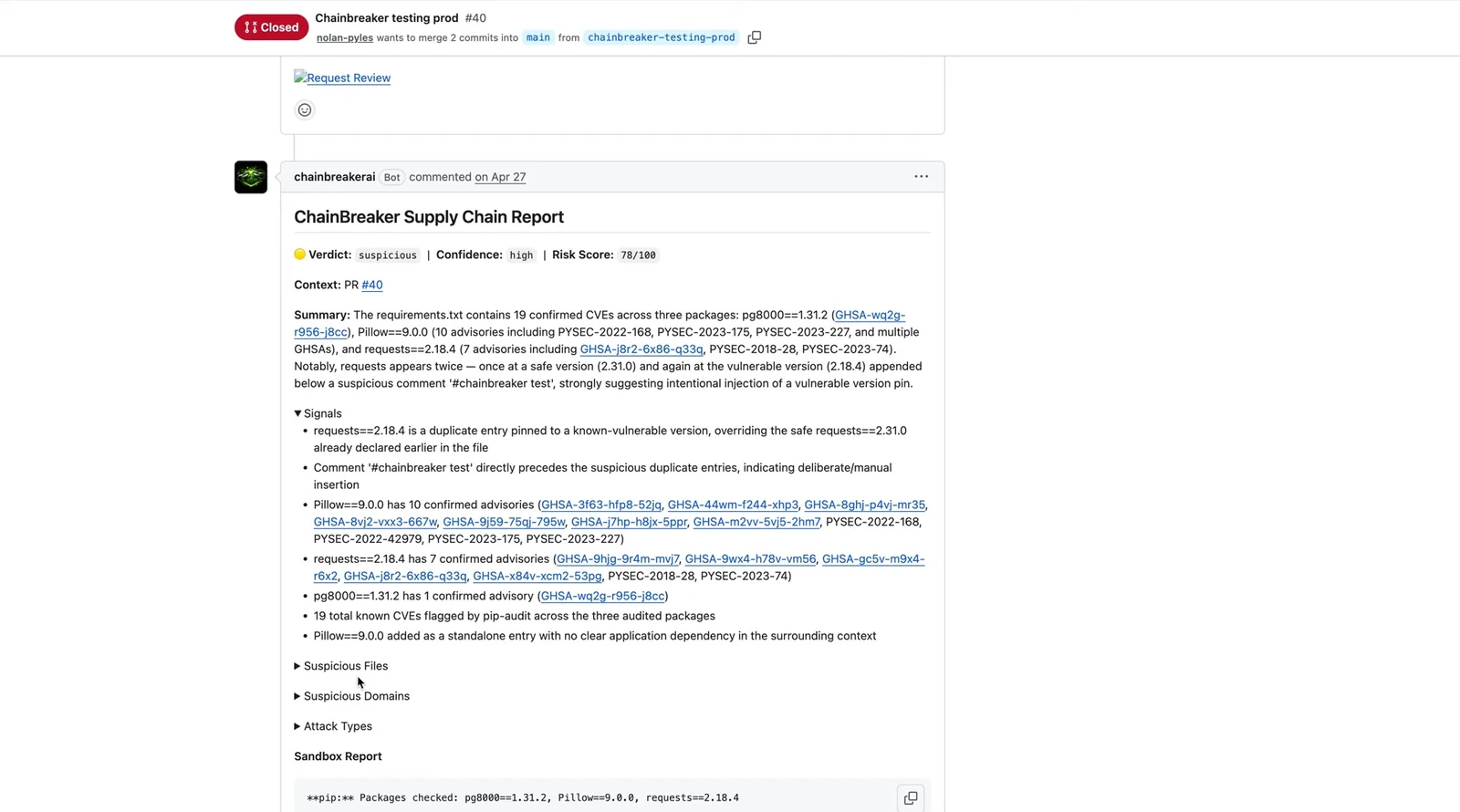
An expanded view of the supply chain report with additional details on suspicious flows.
Who benefits from using ChainBreaker?
ChainBreaker is particularly beneficial for enterprises and institutions facing the challenge of managing extensive supply chains with numerous dependencies. It is designed for security and compliance leads, developers, and IT teams who require a robust solution to preemptively address vulnerabilities. With the exponential growth of AI development, the number of dependencies and potential vulnerabilities increases, making tools like ChainBreaker essential. By integrating ChainBreaker into your CI/CD pipeline, you can prevent attack vectors from slipping into your code base, ensuring a secure development lifecycle. Universities and enterprises that prioritize data integrity and security will find ChainBreaker an invaluable addition to their cybersecurity arsenal.
Try ChainBreaker for your enterprise
To experience the full capabilities of ChainBreaker, we invite you to integrate it into your enterprise's workflow. By doing so, you'll gain a comprehensive understanding of how it can enhance your security posture. ChainBreaker's seamless integration with GitHub and Slack ensures that it fits easily into your existing processes, allowing for immediate benefits. To see ChainBreaker in action, you can watch the ChainBreakerDemo. For more information and to get started with ChainBreaker, visit our Enterprise page.
Frequently Asked Questions
Common questions and detailed answers about this topic
Resources & Further Reading
Trusted references and external documentation
Author's Thoughts
ChainBreaker Agent offers a proactive solution for enterprises looking to secure their supply chains against a growing array of cyber threats. By implementing ChainBreaker, you can ensure your organization is protected from vulnerabilities and malicious code before they reach production. To learn more about how ChainBreaker can benefit your organization, visit our Enterprise page.
This article answers:
- How does ChainBreaker protect against supply chain threats?
- What is the role of AI in supply chain security?
- Can ChainBreaker integrate with Slack?
- How does ChainBreaker handle CVEs?
© 2026 Fusion Cyber. All rights reserved.