

DoWI 8430.01 Explained: What Accelerated Mission Software Means for Defense Software Teams
Overview
DoW Instruction 8430.01, Accelerated Mission Software, establishes policy and responsibilities for modernizing and managing software across the Department of War (DoW). The instruction became effective on September 8, 2026 and applies across the software lifecycle, including acquisition and non-acquisition programs containing software, subject to the instruction's stated exclusions and provisions.
The directive connects software delivery with mission outcomes. Instead of treating software development, security, testing, operations, and governance as separate activities, it emphasizes continuous feedback, built-in security and quality, automation, enterprise reuse, operational testing, measurable outcomes, and evidence.
For defense software teams, this means the practical question is no longer:
Can we build and deploy the software?
It becomes:
Can we build, secure, test, operate, measure, and continuously improve mission software while producing evidence that demonstrates its performance and assurance?
This article explains what DoWI 8430.01 means for defense software teams and how organizations can translate its requirements into workforce development, cyber-range exercises, secure AI-assisted development, operational testing, software supply-chain visibility, and reusable evidence.
What Is DoWI 8430.01?
DoWI 8430.01, titled Accelerated Mission Software, establishes policy, responsibilities, and procedures for software modernization and management within the DoW.
The instruction applies broadly to software throughout its lifecycle and covers acquisition and non-acquisition programs that contain software, including applicable national security systems and defense business systems, regardless of dollar value, subject to the instruction's provisions.
Its central objective is to accelerate mission software without separating speed from security, quality, resilience, and accountability.
The Software Lifecycle Under DoWI 8430.01
| Lifecycle area | What teams need to demonstrate |
|---|---|
| Plan | Mission-aligned priorities, architecture, workforce, and governance. |
| Develop | Modern software practices with security and quality built into development. |
| Secure | Security validation, supply-chain controls, provenance, and risk management. |
| Test | Continuous testing, operational evaluation, adversarial testing, and performance measurement. |
| Operate | Continuous monitoring, operational telemetry, and mission-focused feedback. |
| Measure | Validated performance, security findings, evidence, and workforce readiness data. |
| Improve | Continuous feedback and iterative improvement based on operational results. |
What Does "Accelerated Mission Software" Mean?
The instruction's approach is built around modern software practices that reduce unnecessary delays while preserving security and mission assurance.
Rather than relying on long, isolated development phases, teams are expected to create a continuous feedback loop:
Plan → Develop → Secure → Test → Operate → Measure → Improve
This approach supports software that can evolve as mission requirements, threats, technologies, and operational conditions change.
The Seven Modern Software Tenets
DoWI 8430.01 identifies modern software principles that shape this operating model.
- Embrace continuous feedback. Teams should continuously learn from users, operations, testing, and mission outcomes.
- Optimize flow, not phases. The objective is to improve the movement of value through the software lifecycle rather than optimize isolated phases.
- Build security and quality in. Security and quality should be integrated into development rather than treated only as final-stage gates.
- Automate. Automation should reduce repetitive work and support faster, more reliable software delivery and assurance.
- Architect for evolvability and scale. Software should be designed to adapt as mission requirements and technology change.
- Default to enterprise reuse. Organizations should leverage reusable capabilities and avoid unnecessary duplication.
- Align governance with speed. Governance should support mission outcomes and accelerated software delivery rather than create avoidable friction.
These principles make DevSecOps, automated testing, operational telemetry, continuous authorization strategies, and reusable evidence important parts of the overall software model.
How DoWI 8430.01 Changes the DevSecOps Conversation
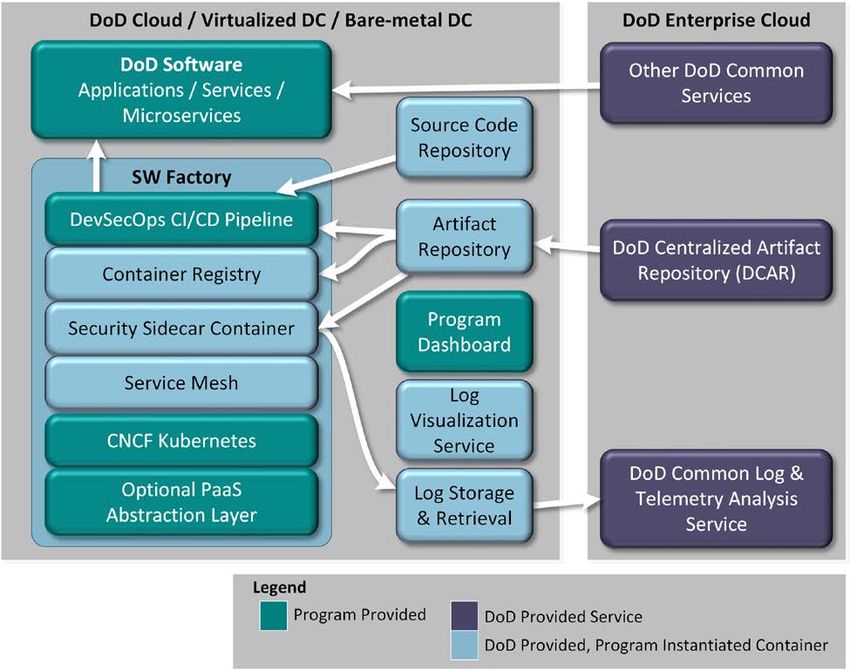
DevSecOps is not simply about deploying software faster. For defense organizations, the delivery pipeline also has to support security, quality, testing, traceability, and operational assurance.
| Traditional focus | Accelerated mission software focus |
|---|---|
| Development followed by separate testing | Continuous testing integrated with delivery |
| Security reviews concentrated near release | Security and quality built into the lifecycle |
| Manual evidence collection | Automated and reusable assurance evidence |
| Periodic operational feedback | Continuous feedback and operational telemetry |
| Software treated as a project deliverable | Software treated as an evolving mission capability |
A defense software team therefore needs more than a CI/CD pipeline. It needs a measurable operating model that connects development activity to security, testing, operational performance, and evidence.
AI-Generated Code and Software Assurance
DoWI 8430.01 also addresses the use of artificial intelligence in software development.
AI can accelerate coding, testing, documentation, analysis, and other engineering activities. But acceleration does not remove human responsibility.
The instruction emphasizes areas including:
- Human responsibility and accountability for AI-enabled software activities.
- Protection of government data.
- Security validation of AI-generated code.
- Use of approved AI applications and environments.
- Reliable AI and appropriate AI component transparency.
- Training for personnel using AI in software-related activities.
For development teams, this creates an important distinction:
AI-assisted development can accelerate software delivery, but generated code still needs appropriate security validation, testing, review, and accountability.
Organizations implementing AI-assisted development should therefore be able to demonstrate how AI-generated or AI-assisted code moves through secure development and testing processes.
For teams building these capabilities, Fusion Cyber's GenAI Application Engineering training can be used as part of a broader secure-AI workforce strategy.
Software Supply Chain Security
Accelerated software delivery increases the importance of understanding what software is being delivered and what components it depends on.
DoWI 8430.01 addresses software supply-chain risk, including areas such as:
- Software component transparency.
- Build integrity and provenance.
- Software Bills of Materials (SBOMs).
- Supply-chain monitoring.
- Third-party and open-source software risk.
- Evidence that supports software assessment and continuous monitoring.
A useful implementation model is to connect the software dependency to its risk, evidence, and remediation activity.
| Supply-chain activity | Operational question | Useful evidence |
|---|---|---|
| Component inventory | What software components are included? | SBOM and component inventory |
| Dependency monitoring | Which dependencies introduce new risk? | Dependency findings and alerts |
| Provenance | Where did the component or build originate? | Build and provenance records |
| Remediation | How was identified risk addressed? | Patch, pull request, validation, and closure records |
| Continuous monitoring | How is risk tracked after deployment? | Monitoring data and recurring assessments |
Fusion Cyber's ChainBreaker agent for AI-powered supply-chain defense provides a relevant example of how AI can help correlate software dependencies, vulnerability signals, and remediation workflows.

Operational Testing and Mission Context
One of the important shifts in DoWI 8430.01 is the emphasis on operationally relevant testing.
The instruction connects operational evaluation with modern software delivery practices and identifies mechanisms such as:
- Continuous monitoring.
- Adversarial testing.
- Cyber ranges.
- Validated automated test artifacts.
- Security scans.
- Performance data.
- Operational telemetry.
This means teams should not only ask whether a feature works in a development environment. They should also understand how the software performs under realistic mission conditions.
Why Cyber Ranges Matter
A cyber range provides a controlled environment where teams can exercise software, infrastructure, security controls, and operational decisions under realistic conditions.
For defense software teams, a range can connect training and testing to measurable evidence.
| Range activity | Potential evidence |
|---|---|
| Mission scenario | Scenario configuration and objectives |
| Security exercise | Findings, detections, and response actions |
| Performance exercise | Scenario scores and operational metrics |
| Adversarial testing | Attack paths, observed behavior, and outcomes |
| After-action review | Lessons learned and remediation actions |
| Repeat exercise | Performance comparison and improvement evidence |
Learn more about Fusion Cyber's cyber range capabilities or read What Is a Cyber Range and Why Is It Vital in 2026 Cybersecurity Training?.
Workforce Readiness and DoD 8140
Technology alone does not create a mission-ready software organization.
DoWI 8430.01 emphasizes an adaptable and skilled workforce, continuous improvement, and performance-oriented assessment. This creates a direct connection between software modernization and workforce development.
DoD 8140 is also relevant because it establishes a qualification-based workforce framework for covered cyber work roles.
| Workforce need | Implementation approach | Evidence |
|---|---|---|
| Role alignment | Map personnel to applicable work roles. | Role mapping and workforce inventory |
| Qualification readiness | Identify applicable approved qualifications. | Qualification map and status |
| Continuous learning | Use recurring learning, exercises, and assessments. | Activity history and competency records |
| Performance assessment | Evaluate personnel in realistic mission scenarios. | Scenario results and readiness metrics |
| Improvement | Use assessment results to target skill gaps. | Improvement plan and reassessment results |
For a deeper workforce perspective, see DoD 8140 Compliance: Mapping Your Cyber Workforce to Approved Qualifications.
From Training to Evidence
A useful way to implement the workforce and operational aspects of DoWI 8430.01 is to connect learning activities directly to mission exercises and measurable evidence.
Learn → Exercise → Perform → Prove → Improve- Learn: Develop the technical and mission knowledge required for the role.
- Exercise: Apply that knowledge in realistic scenarios.
- Perform: Measure decisions, actions, security outcomes, and technical performance.
- Prove: Capture structured evidence of what was performed and what the exercise demonstrated.
- Improve: Use findings and performance data to target the next learning or operational cycle.
This approach can turn training from a one-time event into a continuous readiness process.
What Defense Contractors Should Prepare
Defense contractors supporting DoW software programs should consider how their software workforce, engineering processes, testing practices, and evidence models align with the instruction's direction.
| Area | Questions to ask |
|---|---|
| Workforce | Are software and cybersecurity roles clearly defined and supported by appropriate qualifications and continuous learning? |
| Development | Are security and quality integrated into the development lifecycle? |
| AI | Can the organization validate AI-generated code and maintain human accountability? |
| Supply chain | Can the organization identify software components, dependencies, vulnerabilities, and provenance? |
| Testing | Can the team demonstrate continuous testing and operationally relevant evaluation? |
| Telemetry | Can operational data be captured and used for continuous improvement? |
| Evidence | Can assessment and assurance artifacts be reused across relevant workflows? |
| Continuous improvement | Can the organization show how findings lead to remediation and improved performance? |
The objective is not to create documentation for its own sake. The objective is to make software delivery, security, testing, workforce readiness, and evidence part of one repeatable operating model.
How Enterprises Can Operationalize DoWI 8430.01
For organizations managing multiple software teams, programs, environments, or contractors, implementation can become difficult when training, cyber ranges, software security, compliance workflows, and operational data exist in separate systems.
A more practical approach is to connect these activities.
| Capability | Operational purpose |
|---|---|
| Role-based workforce development | Build skills aligned to mission responsibilities and applicable workforce requirements. |
| Cyber-range exercises | Test personnel and software in realistic environments. |
| Secure AI development | Develop and validate software using AI-assisted workflows with appropriate controls. |
| Software supply-chain analysis | Identify dependencies, vulnerabilities, and remediation requirements. |
| Operational telemetry | Measure what happens during realistic mission exercises and operations. |
| Evidence workflows | Convert activities and results into structured, reusable artifacts. |
Organizations looking to connect these capabilities can explore Fusion Cyber's Enterprise platform.
RangeSherpa and Mission Evidence
RangeSherpa can support the operational side of this model by providing mission-realistic environments where teams can configure exercises, perform technical and security activities, and capture results.
A practical evidence workflow can include:
- Scenario configuration.
- User decisions and actions.
- Security findings.
- Technical telemetry.
- Performance results.
- Event timelines.
- After-action findings.
- Exportable evidence.
The value is the connection between exercise → performance → evidence → improvement.
For a practical example of RangeSherpa supporting secure cloud operations, see RangeSherpa: Secure AWS S3 Management Simplified.
For compliance workflow integration, see How RangeSherpa Streamlines Compliance with ServiceNow CAM.
DoWI 8430.01 Is More Than a Checklist
DoWI 8430.01 should not be approached as a document-production exercise.
Its software modernization model connects several activities that organizations often manage separately:
Workforce → Development → Security → Testing → Operations → Evidence → Improvement
When these activities are connected, organizations can move toward a software delivery model that is faster while remaining measurable, secure, and mission-focused.
That is particularly important as defense organizations adopt AI-assisted development, increase software delivery velocity, depend on complex software supply chains, and integrate operational feedback into continuous development.
How Fusion Cyber Can Support Implementation
Fusion Cyber's approach combines workforce development, cyber-range exercises, AI-enabled capabilities, secure development, and operational evidence.
Relevant capabilities include:
- DoWI 8430.01 implementation support for workforce, testing, secure AI development, and evidence workflows.
- Enterprise capabilities for organizations that need connected training, cyber-range, security, and operational workflows.
- Cyber-range environments for realistic exercises and performance assessment.
- AI Cyber RMF & Defense for AI-enabled security, RMF, and defense workflows.
- GenAI Application Engineering for secure AI-assisted software development.
Organizations should evaluate their own requirements, applicable policies, contracts, and compliance obligations before determining whether their implementation satisfies DoWI 8430.01. Fusion Cyber supports implementation activities; it does not independently certify an organization as compliant with the instruction.
Frequently Asked Questions
Common questions and detailed answers about this topic
Resources
Trusted references and external documentation
Author's Thoughts
DoWI 8430.01 reflects a broader shift in how defense organizations think about software. Faster delivery is important, but acceleration has to remain connected to security, operational performance, workforce capability, and measurable evidence.
The organizations best positioned to operationalize this model will be those that can connect development, testing, workforce readiness, operational telemetry, and evidence instead of treating them as isolated processes.
For defense software teams, the practical starting point is to map the instruction's priorities to the capabilities and evidence already present in the organization, identify gaps, and build a repeatable improvement cycle.
This Article Answers
- What is DoWI 8430.01?
- When did DoWI 8430.01 become effective?
- What does Accelerated Mission Software mean?
- How does DoWI 8430.01 affect DevSecOps?
- How does the instruction address AI-generated code?
- Why are SBOMs and software supply-chain security important?
- Why are operational testing and cyber ranges relevant?
- How does workforce readiness connect with DoD 8140?
- What evidence can organizations capture from software and workforce activities?
- How can defense organizations begin operationalizing DoWI 8430.01?